Plate Tectonics
Definition:
Theory that the earth’s crust and mantle are broken into pieces that move and float around on a plastic like layer of the earth’s mantle.
Continental Drift- Wegener's hypothesis that all continents were once connected in a single large landmass that broke apart about 200 million years ago & drifted slowly to their current position.
There are three types of plate boundries:
1. Convergent- Two plates collide or move towards one another.
2. Divergent- Two plates move away from each other.
3. Transform- Two plates move past one another either in opposite directions at the same time or at different speeds at the same direction.
Convergent plate boundries
Continental Collision- When two continental plates collide over land.

Subduction Zone- When one continental and oceanic plate collide The oceanic plate is less dense and sinks or submerges under the other.

Divergent plate boundries
Rift Valley- Two plates move away from each other.
Ex. The great rift valley in africa.

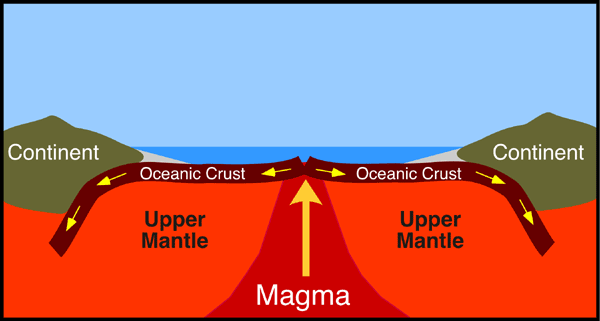
Seafloor Spreading- Two plates move away from each other underwater, mid-ocean ridges form at the opening between the plates on the seafloor. Rocks located at the center of the ridges are younger then the ones on the end. Hess's theory that the new seafloor is formed when magma is forced upward toward the surface at mid-ocean ridge.
Transform plate boundries
Most transform faults are found on the ocean floor. Earthquakes are common in these areas when one plate grinds horizontally past another. Few occur on land, for example the San Andreas fault zone in california. This is a transform fault that connects the pacific plate and the north american plate.

